Market Notes
The Allocator Brief No. 1: Higher Rates, Trillion Dollar Rounds, and the Return of Vintage FOMO
A new recurring column on macro cross currents and what they mean for portfolio construction, plus the people moves worth noticing.
Matthew S. · Founder, Allocator Desk · September 2026 · 9 min read
Welcome to The Allocator Brief, a recurring column about the market cross currents that actually change how a portfolio gets built. Not a news wire. Fewer facts, more argument. If you want headlines, you already have twelve newsletters for that. This is the part where someone tries to connect them.
Today gave us a useful set. Another quarter point on the policy rate, with a forward curve that is not pretending this was the last one. A rare oil deal signed into one of the most sanctioned barrel patches on earth. An OpenAI round being discussed at a valuation with a comma most of us have never typed. And a large endowment naming a new chief investment officer.
Four unrelated stories, one theme. The cost of capital is rising while the price of scarcity is rising faster, and private portfolios are being quietly sorted into the ones that owned the scarce thing and the ones that did not. The new CIO is the human mechanism through which that sorting happens: re-up decisions under new leadership are where owning the scarce thing either gets renewed or quietly unwound.
!Interest rate chart on an institutional desk at dusk

The push and pull on rates
Another quarter point is not a regime change. What matters is the shape of the expectation behind it. When the market believes one hike is the start of a sequence rather than the end of one, three things happen inside a private markets portfolio before anyone updates a model.
First, the hurdle argument gets interesting again. A preferred return of eight percent looked generous when cash paid nothing and slightly absurd when short rates crossed five. Manage that number as a term, not a formality. If you want the mechanics, we walked through hurdles, catch ups, and waterfalls in the fees and terms guide.
Second, leverage cost stops being a footnote in the model and starts being the model. Underwriting from three years ago that assumed a refinancing window is now underwriting that assumes a favor. Ask managers which portfolio companies have maturities inside twenty four months, and what the plan is that does not involve the phrase "market conditions improve."
Third, and least discussed, the denominator effect works in reverse when public markets stay strong. Public books rise, private marks lag, allocation percentages drift below target, and the committee that was over allocated in 2023 is suddenly under allocated and feeling behind. Being told to deploy faster is not the same as finding something worth buying. That is a pacing problem, and pacing problems are solvable with arithmetic rather than adrenaline. If yours needs a rebuild, start with the commitment pacing model.
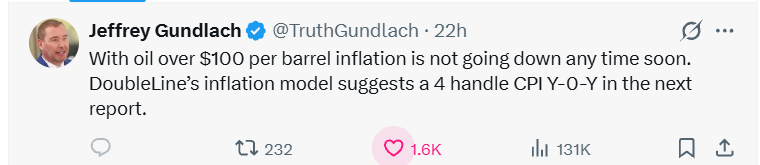
One outside voice is worth taking seriously on the inflation half of this. Jeffrey Gundlach, who runs DoubleLine, put it plainly recently: with oil holding above one hundred dollars a barrel, inflation is not going down any time soon, and his shop's model points to a CPI print with a four handle year over year in the next report. If that lands, the sequence is hikes plus stickiness, which makes the pacing and hurdle math above tighter rather than friendlier.
!Jeffrey Gundlach's public post on oil, inflation, and the CPI outlook
Sanctioned barrels and the return of the hard trade
Continental Resources striking a deal with Venezuela's state oil company, PDVSA, is not really a commodity story. It is a signal about risk appetite. When operators start pricing political and legal complexity as an opportunity rather than a disqualifier, spreads have compressed enough that the easy trades are gone.
Here is what makes the timing interesting. Corporate balance sheets across the energy sector are in the best condition they have been in years, and just about every group with capital is searching for the same land. So even with oil holding near one hundred dollars, it is a tight market: when everyone is flush and everyone is bidding on the same acreage, the scarce thing is not the resource, it is entry price. Capital does not walk toward legal complexity because the returns are fat. It walks there because the ordinary trade is crowded. Sometimes that is genuine alpha. Sometimes it is beta wearing a hard hat.
A trillion dollar conversation, and what it does to your vintages
Reports that OpenAI is raising a new round at a valuation above a trillion dollars are the most important number for anyone building a private portfolio right now. Not because the number is defensible. Because of what it does to dispersion.
Consider two venture and growth programs of similar size, similar quality of process, and the same vintage years. One got into the handful of private companies the entire market is chasing: OpenAI, Anthropic, SpaceX. The other did not, because allocation was rationed, the pro rata was taken by an existing holder, or the investment committee thought the entry price was silly. Over five years, those two programs will not look like variations of the same strategy. They will look like different asset classes.
That is not manager skill in the traditional sense. That is access. And access is being distributed by relationships and check size rather than by insight, which is exactly the condition that produces what we are all watching now: a classic case of fear of missing out on current vintages.
You can see it in behavior. Re-ups happening earlier and larger than the pacing plan allowed. Co-invest capital deployed with less diligence and more speed. Committees approving names they cannot describe in a sentence. Continuation vehicles accepted because saying no feels like leaving the party early.
Two thoughts on that.
The first is uncomfortable: some of the FOMO is rational. If a small number of private companies genuinely capture a disproportionate share of the value created this decade, then missing them is a permanent impairment to relative performance, not a temporary one. Prudence has a cost, and pretending otherwise is a way of losing slowly.
The second is more useful: rational FOMO still needs a budget. There is a difference between deciding to take concentrated exposure to the AI complex and drifting into it one exception at a time. One is a portfolio decision you can defend to a board. The other is a series of small yeses that adds up to a position nobody sized.
Practical version. Write down the maximum share of the program you are willing to expose to this theme across funds, co-invests, and secondaries. Then check the actual number, including look through exposure inside diversified funds you never thought of as AI vehicles. Most teams find the answer is higher than they assumed, because the same three or four names appear in six different portfolios. We built the benchmarking guide partly for this reason: when a couple of positions drive everything, an internal rate of return tells you almost nothing about repeatable skill.
Reading a vintage that is not finished
Judging a 2024 or 2025 vintage today is an exercise in reading incomplete evidence, and the shape of the curve matters more than the level. If you want the full treatment on where a fund should sit at each stage, the J-curve guide covers it properly. The short version for this cycle:
- Early marks in a hot theme tell you about the market, not the manager
- Fee drag in years one through three is identical no matter how exciting the portfolio sounds
- The first real information arrives when something needs to be sold, not when something gets written up
- Distributions remain the only opinion the market cannot revise
Put differently, the funds that look brilliant right now and the funds that will be brilliant in 2031 overlap, though not nearly as much as today's league tables imply.
What to do in the next thirty days
Not resolutions. Just work that is cheap now and expensive later.
1. Refresh the pacing model with the new rate path and current allocation drift, not last year's assumptions 2. Pull look through exposure to the top ten private AI and frontier technology names across the whole program 3. Set a theme budget, and a written rationale for exceeding it, before the next re-up arrives 4. Ask three managers for their maturity wall by year, in writing 5. Decide which 2026 re-ups you would decline if capacity were unlimited. That list is your real conviction ranking
People on the move
Personnel news is usually filler. Occasionally it is a leading indicator. The Andrew W. Mellon Foundation elevated a long tenured internal leader, Abigail Kahn Archibald, to chief investment officer of its roughly eight billion dollar endowment, and that reads as continuity.
That is the first brief. The plan is a regular cadence: a few macro cross currents, one argument worth disagreeing with, and the people moves that actually signal something. If you want the calendar side of the market, our 2026-2027 private equity and LP event calendar stays current.
Topics
- Macro
- Rates
- Private Equity
- Venture
- Portfolio Construction
- Allocator Brief